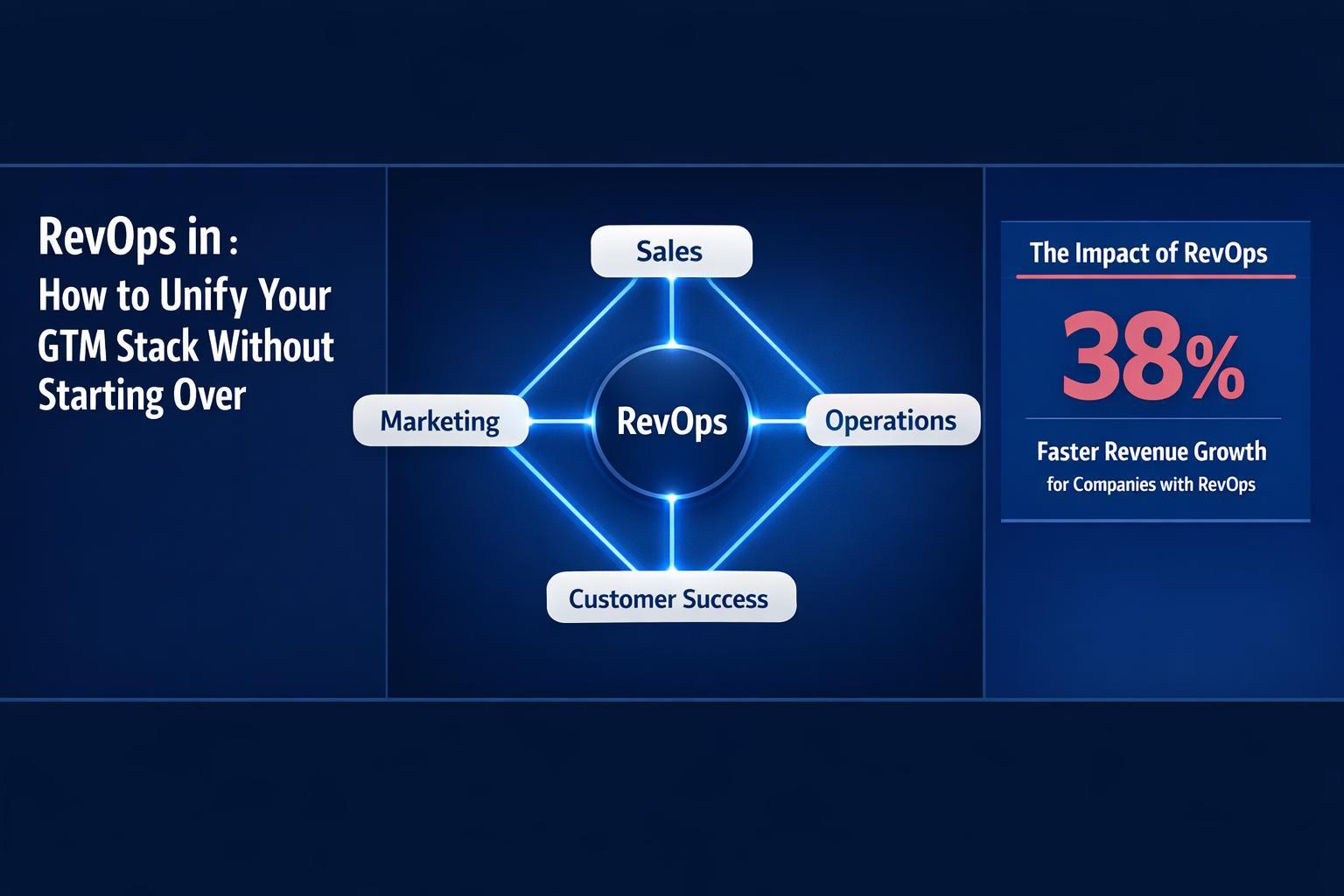
Revenue Operations has gone from a trendy job title to a board-level expectation in the span of three years. In 2026, RevOps leaders are not just being asked to align sales, marketing, and customer success – they are being asked to deliver real-time forecasting, AI-ready data infrastructure, and GTM efficiency at a time when headcount budgets are frozen and tech stacks are already overcrowded.
The old answer – “consolidate everything onto one platform” – is proving increasingly impractical. M&A activity is creating multi-CRM environments. Different regions use different tools. Acquired companies bring their own tech debt. The mandate to “standardize” can cost more in disruption than it saves in efficiency.
So what does smart GTM unification actually look like in 2026?
Principle 1: Unify Data, Not Tools
The core problem in most fragmented GTM stacks is not that teams use different tools – it is that those tools do not share data. When your sales team’s activity lives in Salesforce, your marketing attribution lives in HubSpot, your customer success data lives in Gainsight, and your content engagement data lives in your enablement platform, you get four partial pictures of the customer relationship and no unified view of revenue health.
The RevOps mandate in 2026 is data unification, not tool consolidation. This means identifying a platform layer that can serve as the revenue source of truth – pulling signals from across the stack and surfacing a composite view of deal health, pipeline velocity, and customer engagement without requiring everyone to migrate to a single system.
Principle 2: The Enablement Platform Is Your Connective Tissue
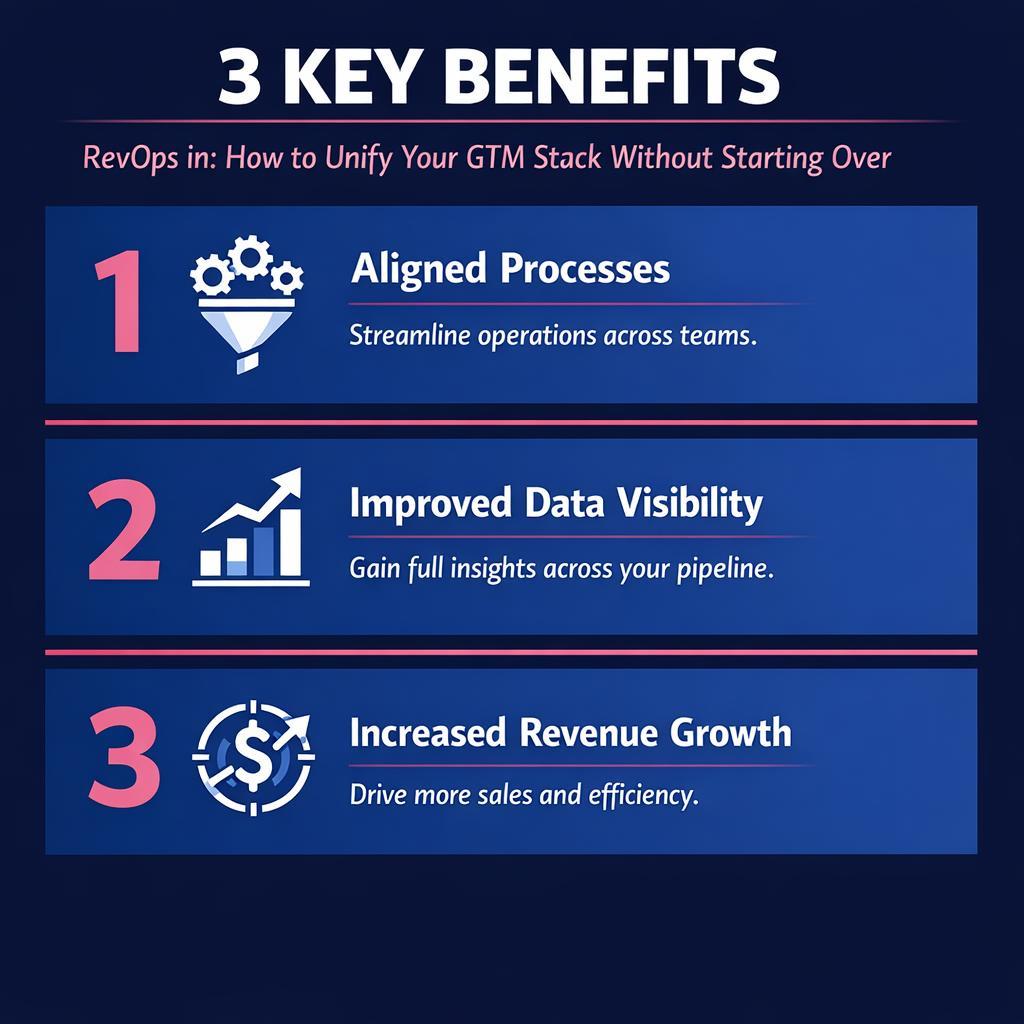
Here is the insight reshaping RevOps architecture: the revenue enablement platform – not the CRM – is emerging as the most natural connective layer across GTM. Here is why.
The CRM captures what happened. The enablement platform captures what is happening – live buyer engagement, content consumption, deal room activity, coaching signals. These are the leading indicators that predict whether a deal will close, stall, or die – and they exist in the enablement layer, not the CRM.
Revspire’s architecture connects directly to your CRM, pulling context in and pushing deal intelligence back out. The rep works in the deal room. The deal room talks to the CRM. The forecast reflects real-time engagement data, not just stage updates. Explore the Deal Room, Content Hub, and CPQ together to see how these layers connect.
Principle 3: AI Readiness Requires Clean Signals, Not Just Clean Data
Every RevOps leader is under pressure to deploy AI across their GTM stack. The challenge: most AI deployments underperform not because the AI is bad, but because the underlying data is too thin, too noisy, or too disconnected to be useful.
A CRM full of manually entered stage updates and empty activity fields will not produce useful AI forecasts. The signal quality required for meaningful AI – predictive deal scores, risk alerts, next best action recommendations – comes from behavioral data: buyer engagement patterns, content interaction, stakeholder activity, call intelligence.
The practical implication for RevOps leaders: before buying an AI forecasting tool, invest in the signal infrastructure that feeds it. A connected revenue enablement platform that captures rich behavioral data from every deal is the foundation. The AI is the application layer on top.
Principle 4: Simplify Seller Experience, Even If the Back-End Is Complex
The biggest RevOps mistake in platform consolidation projects is optimising for the administrator experience at the expense of the seller experience. The result: a technically elegant system that no one uses properly because it requires too many clicks, too many tool switches, and too many manual updates.
Every tool added to the seller’s workflow should remove friction, not add it. Revspire’s philosophy is that the rep should do their entire deal management workflow from a single deal room – and the underlying data sync, content curation, coaching signal, and CPQ integration should happen without requiring the rep to leave that environment.
What RevOps Success Looks Like in 2026
The GTM organisations winning in 2026 share a common profile: unified deal data, AI-ready signal infrastructure, seller-centric workflow design, and tight alignment between what marketing produces, what sales uses, and what buyers actually engage with. None of this requires burning down your existing stack. It requires the right connective layer – and the discipline to build around it strategically.
See how Revspire fits into a modern RevOps architecture – explore why revenue teams choose Revspire.
Leave a Reply