Product-led growth and enterprise sales have been positioned as opposing philosophies for most of the last decade. PLG teams believed that great products should sell themselves; enterprise sales teams believed that complex deals required human orchestration that no product experience could replace. In 2026, this debate is over — the answer is both, and the companies that figure out how to combine them are building an enormous competitive moat.
Why the PLG vs. Enterprise Sales Debate Was Always a False Choice
The original PLG thesis was built on a real insight: buyers in the modern era want to experience a product before committing to it, and friction in the evaluation process reduces conversion. Self-serve trials, freemium models, and usage-based pricing removed that friction and created a new category of revenue growth that scaled without linear headcount increases. Companies like Slack, Figma, Notion, and Calendly proved the model spectacularly.
But PLG also revealed its own limits. Self-serve motions are excellent at acquiring individual users and small teams. They are poor at navigating the multi-stakeholder, procurement-heavy, compliance-sensitive buying processes that characterise enterprise deals. An enterprise CISO is not going to approve a company-wide deployment because users love the product. That CISO needs a security review, a data processing agreement, an enterprise SLA, and a relationship with a human being who will pick up the phone when something goes wrong.
The Hybrid GTM Model That 2026 Demands
The hybrid GTM model recognises that PLG and enterprise sales are not competitors — they are stages in the same customer journey. PLG creates the initial user base, generates real usage data that proves value, and provides the signal intelligence that the enterprise sales motion then uses to identify and accelerate expansion opportunities. Enterprise sales then layers human relationship-building, executive engagement, commercial negotiation, and stakeholder consensus-building on top of the product foundation that PLG has already created.
Identifying Enterprise Expansion Signals Inside Your PLG Motion
The Product Qualified Account (PQA) Framework
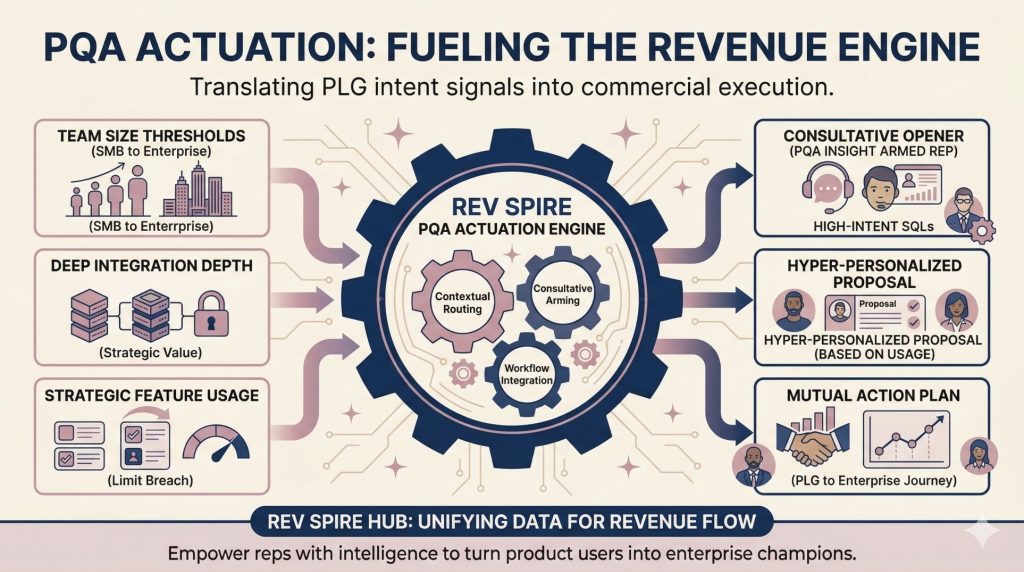
Most PLG teams are familiar with the concept of a Product Qualified Lead (PQL) — a user who has hit specific usage milestones that correlate with conversion to paid. The enterprise equivalent is the Product Qualified Account (PQA): a company in your user base that is exhibiting usage patterns that indicate readiness for an enterprise expansion conversation. PQA signals typically include:
Team size thresholds — when a free or SMB account reaches a user count consistent with enterprise needs, it is a natural expansion trigger. Departmental breadth — when users across multiple departments in the same company are adopting the product independently, it signals organisation-wide value that an enterprise contract can formalise. Integration depth — when an account has integrated your product deeply into their tech stack, switching costs and strategic value are both high. Feature engagement — when a PLG account starts hitting against enterprise feature limits, it is an explicit signal that a sales conversation is welcome, not intrusive.
Arming Enterprise Reps with PLG Intelligence
The critical failure point in most hybrid GTM models is the handoff from product to sales. The product team sees the PQA signals, but the sales team receives them through a CRM alert with no context. The rep calls, knows nothing about how the account is actually using the product, and defaults to a standard discovery call that the user finds insulting. “So, what problems are you trying to solve?” is an embarrassing opener when you have six months of detailed usage data sitting in your product analytics.
Enterprise reps in a hybrid GTM model need to enter every conversation armed with specific usage intelligence: which teams are using the product, which features are being used most heavily, what the account’s engagement trend looks like over time, and what the natural next step is based on their usage pattern. This intelligence is the raw material of a genuinely consultative enterprise sales conversation.
The Enterprise Selling Skills That PLG Cannot Replace
Stakeholder Orchestration
PLG can create enthusiastic user champions. It cannot build the multi-stakeholder consensus required for a seven-figure enterprise contract. That requires a human sales professional who can identify all relevant stakeholders, understand their individual motivations and concerns, sequence engagement in the right order, and navigate the political dynamics of a complex organisation. This is a high-skill capability that no product experience delivers.
Revspire Deal Rooms support enterprise stakeholder orchestration by giving the sales team a shared workspace that the PLG-developed user base can be invited into — connecting the grassroots product enthusiasm to the executive-level business case that closes the enterprise deal.
Commercial Negotiation and Procurement Navigation
Enterprise procurement teams are experienced negotiators with a mandate to extract value from every vendor. Navigating procurement requires commercial acumen, legal knowledge, competitive positioning, and relationship skills that are purely human capabilities. The most effective hybrid GTM teams pair strong enterprise sales skills with the product usage data that gives the sales team unassailable proof of value during commercial negotiations — making it very difficult for procurement to drive the price below a defensible floor when the usage data proves ROI clearly.
Building the Hybrid GTM Operating Model
A hybrid GTM model requires four structural elements to function: a shared definition of PQA between product, sales, and marketing; a real-time signal routing system that surfaces PQA triggers to the right enterprise rep immediately; a cross-functional handoff process that gives the rep full product usage context before first contact; and an enterprise sales motion that uses product usage data throughout the deal cycle as proof of value rather than treating the enterprise conversation as separate from the PLG experience.
Revspire’s Content Hub supports this by enabling enterprise reps to share usage-specific case studies and outcome evidence with buying committee members — connecting the product experience that PLG users already have to the business case that enterprise decision-makers need to see before committing.
How Revspire Fits In
Revspire is designed for hybrid GTM teams. Deal rooms that bridge PLG user engagement and enterprise stakeholder orchestration, content intelligence that surfaces the right assets for each buyer role, and AI-driven coaching that helps enterprise reps act on PLG signals effectively — all in one agentic revenue enablement platform built for 2026.
Book a 20-minute Revspire demo and see hybrid GTM in action.
Leave a Reply