
Revenue forecasting accuracy in 2026 remains one of the most persistent failures in B2B sales operations. Forrester found that fewer than half of all sales forecasts are accurate to within 10% of final results — and this despite billions of dollars invested in CRM platforms, AI forecasting layers, and revenue intelligence tools. The problem is not the model. The problem is the data feeding it.
Why CRM Data Produces Inaccurate Forecasts
CRM data is, at its core, a record of what your sales reps believe is happening. Stage progression, close date estimates, deal size — these are all rep inputs, subject to optimism bias, sandbagging, and outdated information. A deal in “Stage 4: Negotiation” might have had zero buyer activity for six weeks. The rep updated the stage after the last call, forgot to move the close date, and now your forecast is carrying a deal that is effectively dead as if it were two weeks from closing.
The Optimism Bias Problem
Sales reps are inherently optimistic — it is a feature, not a bug. But that optimism systematically inflates forecast confidence. The average rep overestimates close probability by 25–35% on deals in advanced stages, according to research from Clari. When you roll those individual over-estimates into a regional or company forecast, the compounding effect produces forecasts that consistently overshoot reality. Every quarter, the same post-mortem: deals slipped, timing was off, buyer went quiet.
Stage Definitions Do Not Mean the Same Thing to Every Rep
Even when your CRM has perfectly defined stage criteria, implementation is inconsistent. One rep moves a deal to Stage 4 when a verbal commitment is received. Another waits until the contract is out. A third moves it forward after a “great call” where they felt good momentum. Stage data, without activity and engagement data to corroborate it, is structured noise.
What Accurate Revenue Forecasting Actually Requires

Buyer Behaviour Is the Only Leading Indicator That Matters
The most reliable predictor of whether a deal will close on time is buyer behaviour — not rep opinion. Is the buying committee actively engaging with shared materials? Has the CFO viewed the business case? Has IT completed the security questionnaire? Have new stakeholders been introduced into the shared workspace, indicating internal buy-in is growing? These are observable, objective data points that correlate directly with deal outcomes.
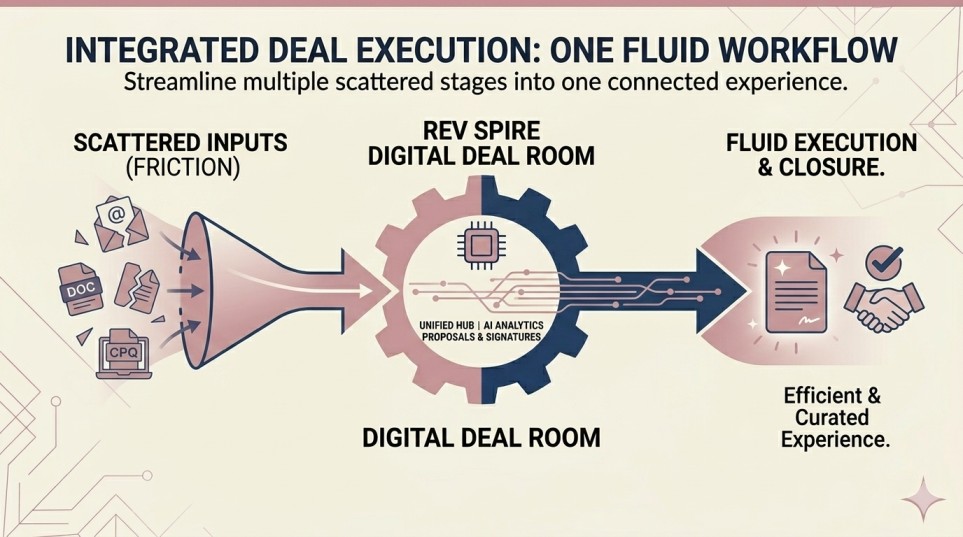
Revspire Deal Rooms capture exactly this data automatically — every view, every download, every stakeholder login, every comment is timestamped and attributed. When you forecast against buyer engagement data rather than rep-entered stage data, you are forecasting against reality rather than hope.
Multi-Stakeholder Engagement Predicts Deal Health
Single-threaded deals — where only one stakeholder is engaged — are 60% more likely to stall or be lost than deals with three or more active buyer-side participants. This is one of the most actionable forecasting signals available, and most teams are not measuring it at all. Build multi-stakeholder engagement into your deal health score and weight it heavily in your forecast model.
Building a Deal Engagement Scoring System
A deal engagement score replaces subjective rep confidence with objective buyer behaviour data. Here is a simplified scoring framework that works:
Recency (0–30 points): When was the last buyer-initiated engagement? Activity within 7 days scores full points; 8–14 days partial; 15+ days a red flag.
Breadth (0–30 points): How many unique buyer-side stakeholders have engaged? Assign points per active stakeholder, capped at the typical buying committee size for your deal size.
Depth (0–25 points): What types of content have buyers engaged with? Pricing documents, security questionnaires, and ROI calculators indicate late-stage seriousness. Blog posts and overview decks indicate early-stage exploration.
Momentum (0–15 points): Is engagement increasing, flat, or declining over the past two weeks? A declining engagement trend on a “commit” deal is the most important early warning signal your forecast system can produce.
Deals scoring above 75 belong in your committed forecast. Deals scoring below 40 should be moved to pipeline risk regardless of what stage the rep has logged them in.
The Role of AI in Forecasting — and Its Limits
AI-powered forecasting tools have improved forecast accuracy by 10–15% in early adopter organisations — but only when they are trained on quality input data. An AI model trained primarily on CRM stage and rep-entered close dates will simply automate the existing bias at scale. The teams seeing the biggest accuracy gains are those who feed their AI models buyer engagement signals, multi-stakeholder interaction data, and deal room activity alongside traditional CRM inputs. The AI does not replace human judgment — it replaces the bad data that was corrupting that judgment.
Revspire’s deal engagement analytics provide the buyer-side signal layer that transforms AI forecasting from noise reduction to genuine prediction — giving revenue leaders the confidence to commit to a number and defend it.
The Forecasting Culture Problem
No forecasting system survives a culture where reps are punished for accuracy. If missing a committed deal leads to a severe consequence but sandbagging leads to no consequence, your reps will sandbag — regardless of what your system tells them to do. The most accurate forecasting cultures reward reps for calling deals correctly, not just for closing them. That cultural shift, combined with a deal engagement data layer, is what separates companies with 85%+ forecast accuracy from those stuck in the 50% range.
How Revspire Fits In
Revspire provides the buyer engagement data layer that makes revenue forecasting accurate. Every interaction your buyers have inside a deal room becomes a signal that informs deal health scoring, pipeline risk flags, and forecast confidence — giving your RevOps team a ground-truth view of deal status that CRM data alone cannot provide.
Book a 20-minute Revspire demo and see how deal engagement data fixes your forecast.
Leave a Reply