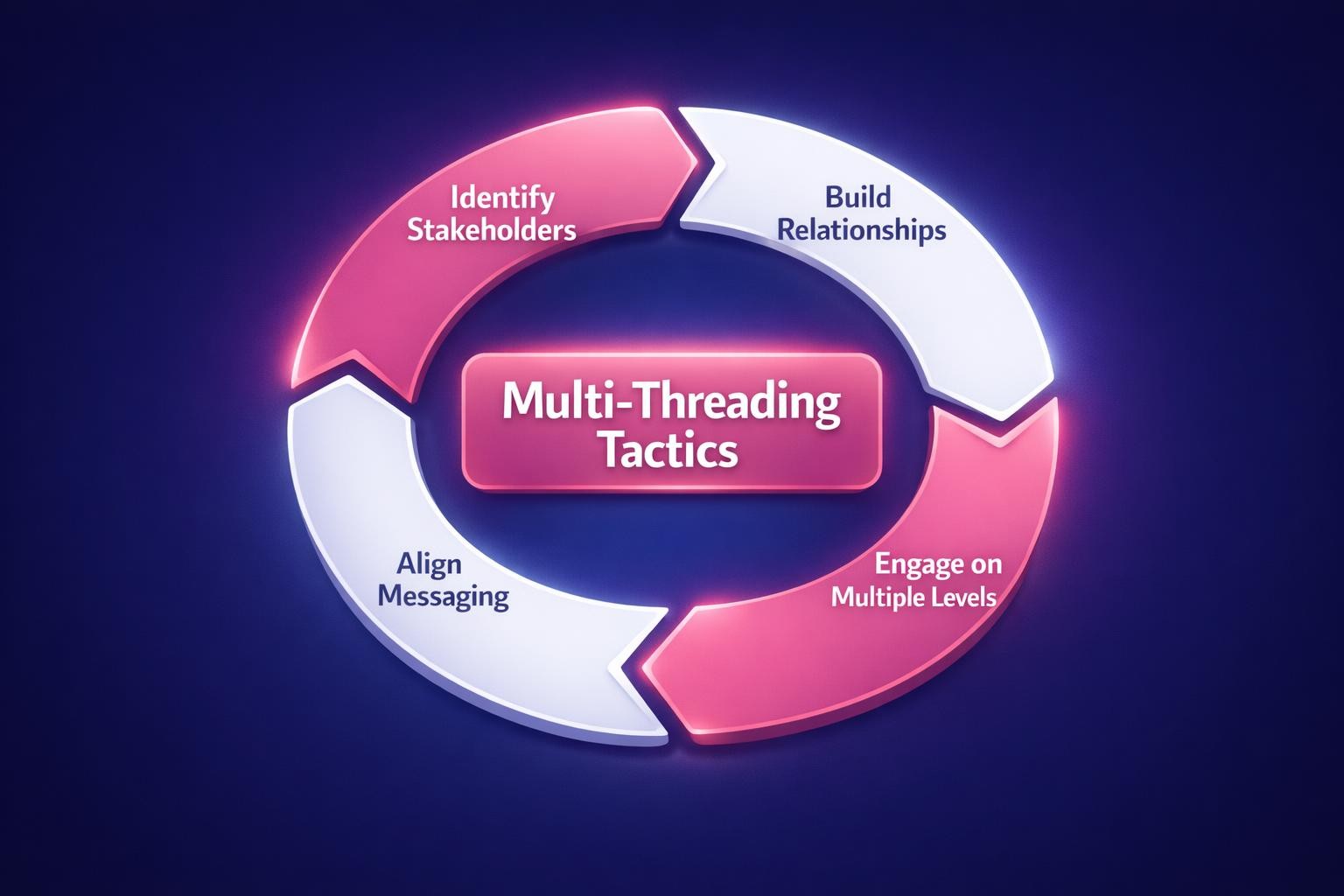
Here is a data point that should get your attention: Top AEs average 4.1 stakeholder contacts per deal vs 1.8 for average reps. If your revenue team is not systematically investing in Multi-Threading Tactics, this gap is almost certainly showing up in your pipeline, your forecast, and your close rates. Here is why it matters more than most leaders realise — and what to do about it.
The Hidden Cost of Ignoring Multi-Threading Tactics
Most B2B revenue leaders know multi-threading tactics enterprise AE matters in principle. But knowing and systematising are very different things. The organisations that treat Multi-Threading Tactics as a strategic priority — not a checkbox — generate measurably different results at every stage of the funnel.
The cost of ignoring it is rarely visible in a single deal. It shows up gradually: in slightly lower win rates, in deals that take two weeks longer than they should, in forecast calls where leaders feel uncertain about what they are seeing. By the time the pattern is obvious, you have already given up significant revenue to competitors who took multi-threading tactics enterprise AE seriously earlier.
Where the Revenue Leakage Happens
Revenue leakage from poor Multi-Threading Tactics practice concentrates in three places. First, deals in early stages that should never enter the pipeline do, consuming rep capacity and distorting the forecast. Second, qualified deals stall mid-cycle because of gaps in multi-threading tactics enterprise AE execution that a structured approach would catch. Third, late-stage deals are lost to process failures — procurement surprises, unstated objections, last-minute stakeholder concerns — that better Multi-Threading Tactics management would have surfaced earlier. Revspire Stakeholder Intelligence is designed to close these gaps at every stage.
The Business Case for Investing in Multi-Threading Tactics
The ROI of multi-threading tactics enterprise AE investment is not abstract. Revenue teams that systematically improve Multi-Threading Tactics see compounding returns: faster ramp times for new reps, higher average deal sizes, lower cost of customer acquisition, and improved forecast accuracy that allows leadership to make better resource allocation decisions. Each of these improvements stacks on the others, creating an increasingly durable competitive advantage over time.
The Competitive Dimension
In markets where your product is differentiated but not unique, Multi-Threading Tactics becomes a key competitive variable. Buyers choose vendors not just on product capability but on how easy and confident the buying experience makes them feel. Teams that excel at multi-threading tactics enterprise AE create a fundamentally better buying experience — one that builds trust, reduces perceived risk, and makes it much harder for a competitor to displace you once the relationship begins.
The Talent Dimension
This is underappreciated: top-performing revenue professionals actively seek out organisations that take Multi-Threading Tactics seriously. When you build a best-in-class approach to multi-threading tactics enterprise AE, you create an environment where the best reps want to work, where they develop faster, and where they stay longer. The talent flywheel that this creates compounds over years.
Making It Real: Where to Start
Start with an honest audit. Where is Multi-Threading Tactics working well today? Where is it breaking down? What does the data say versus what the narrative says? Use that assessment to prioritise two or three specific improvements that will have the biggest impact on revenue outcomes. Deploy them with a clear owner, a measurable goal, and a 90-day review cadence. Then build from there.
Revspire helps B2B revenue teams build this foundation systematically. See a demo and find out why teams using our platform consistently outperform on multi-threading tactics enterprise AE.
Leave a Reply